
EDI & Ion Exchange Resin

EDI modules and high-purity ion exchange resins for continuous, chemical-free demineralization.
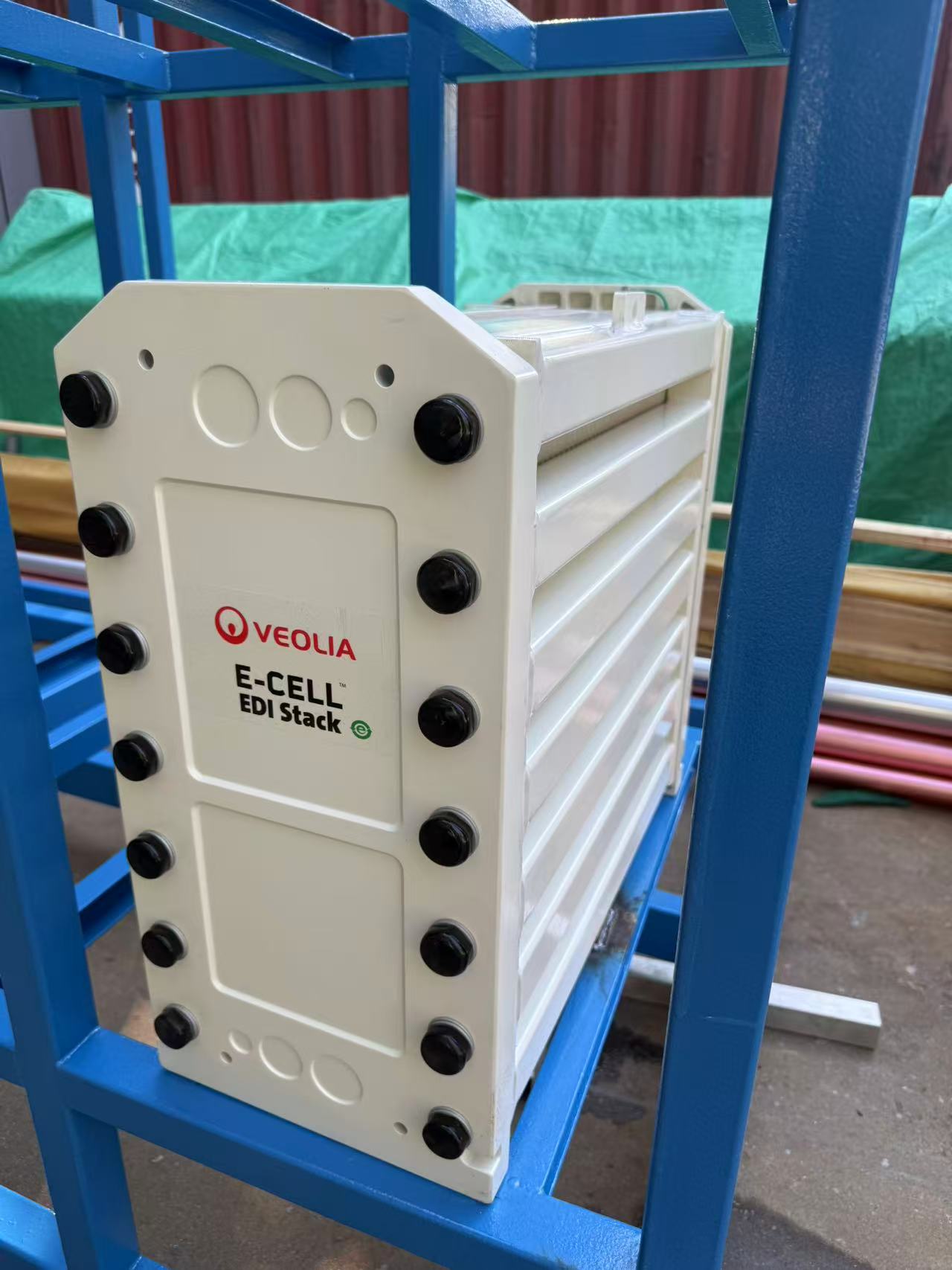
EDI & Ion Exchange Resin

Overview

An EDI module stacks dilute-water, concentrate and electrode-water compartments between anion- and cation-exchange membranes, with ion-exchange resin packed in the dilute compartments and electrodes at both ends. Feed water runs through the dilute compartments and comes out desalinated. Salt ions that leave the dilute compartments cross the membranes into the concentrate compartments and are drained as concentrate water. The electrode compartments host the electrode reactions and discharge electrode water separately.

  • The resin is regenerated in place by the H⁺ and OH⁻ ions that water itself produces when it splits under the DC field. No hydrochloric acid, no caustic soda, and no acid-alkali waste to dispose of.
  • Highly automated and simple to operate. The unit runs unattended around the clock and can be integrated into a DCS automatic control system.
  • Small footprint. Compared with a conventional mixed-bed system, the acid-alkali storage tanks, regeneration water tanks and neutralization tanks are eliminated, which reduces the civil-engineering floor area.
  • Low operating cost. No chemical purchasing; the unit mainly consumes a small amount of electric power, concentrate water and electrode water.
  • Stable ultrapure water output at 15–18.2 MΩ·cm, with better removal of weak electrolytes such as silica and CO₂ than a single-stage RO.
Request a Quote
Applications

Where It’s Used

Specifications

Technical Specifications

EDI product15–18.2 MΩ·cm ultrapure water, stable output
Module structureDilute, concentrate and electrode compartments; anion- and cation-exchange membranes; ion-exchange resin; electrodes
RegenerationIn place, by H⁺ and OH⁻ from water ionization; no acid or caustic
OperationAutomated, unattended 24-hour operation, DCS-ready
FootprintCompact; no chemical storage, regeneration or neutralization tanks
Operating costNo chemical procurement; low power, concentrate and electrode-water consumption
Flow rangeTo be confirmed per module model
FAQ

Frequently Asked Questions

Does the resin need chemical regeneration?
No. The DC field splits water into H⁺ and OH⁻, and these ions keep the resin regenerated in place. There is no hydrochloric acid, no sodium hydroxide and no acid-alkali waste liquid.
How pure is the water?
The unit delivers stable ultrapure water at 15–18.2 MΩ·cm. Weak electrolytes like silica and CO₂ are removed better than with a single-stage RO.
Does it need an operator on site?
No. It is designed for unattended 24-hour operation and can be tied into a DCS automatic control system.
What does it cost to run?
There is no chemical purchasing. Running cost is mainly a small amount of electric power, concentrate water and electrode water.
How much floor space does it need?
Much less than a conventional mixed bed. With no acid-alkali storage, regeneration water or neutralization tanks, the civil-engineering footprint is smaller too.
Related

Related Products

Ready to solve your water challenge?

Send us your water analysis and target quality — our engineers reply within 24 hours with a costed proposal.

Get a Quote